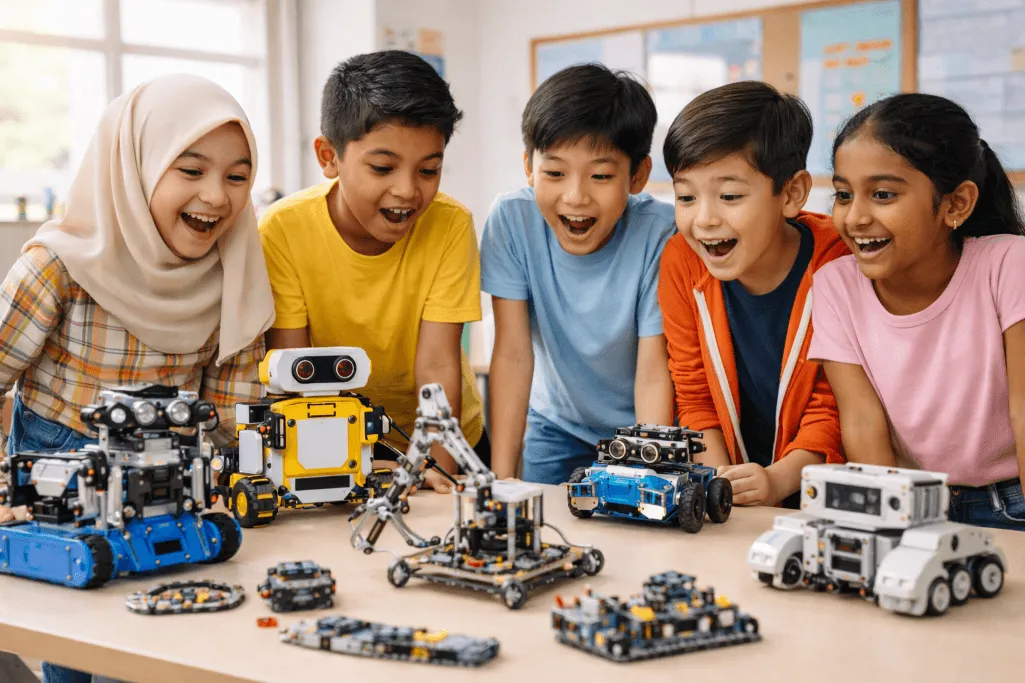
Why Robotics Education Matters Today
Industry is evolving at an unprecedented pace. Automation, artificial intelligence, data-driven manufacturing and interconnected production systems are no longer futuristic concepts. From smart factories to predictive maintenance systems, Industry 4.0 is reshaping how businesses operate.
Yet, many education systems are still catching up.
A clear skills gap exists between classroom learning and real-world industrial requirements. Employers increasingly demand graduates who are not only theoretically competent, but also confident in automation systems, robotics integration and digital control technologies.
This is where Robotic Education Equipment becomes essential. By introducing structured, industry-aligned robotics training into schools, universities and technical institutions, educators can bridge the divide between theory and practical competence. This helps to prepare students for careers in engineering, manufacturing, automation and beyond.
Forward-thinking institutions are no longer asking whether to adopt robotics education, but how soon they can implement it effectively.
What Is Robotic Education Equipment?
Robotic Education Equipment refers to structured training systems designed to teach robotics, automation and control principles in an academic or technical training environment. Unlike hobbyist kits, professional educational robotics platforms are engineered to simulate real industrial applications while remaining safe and curriculum-friendly.
Examples of Robotic Education Equipment include:
- Educational robotic arms that replicate industrial manipulator movements
- Programmable robots for coding and automation logic training
- Automation training kits with PLC integration
- Mechatronics and control system trainers
- Conveyor-based smart manufacturing simulation modules
It is important to distinguish between educational robotics and industrial robotics:
Educational Robotics | Industrial Robotics |
Designed for learning environments | Designed for production lines |
Safe, modular, curriculum-based | High-speed, heavy-duty systems |
Supports training and experimentation | Focused on efficiency and output |
Well-designed robotic education equipment provides exposure to industrial concepts without the risks or complexity of full-scale factory automation systems.
How Robotic Education Equipment Supports Industry 4.0 Learning
Industry 4.0 is built on interconnected technologies such as robotics, IoT, AI, data analytics and smart automation. Teaching these concepts through textbooks alone is insufficient.
Hands-on learning transforms understanding into capability.
Practical Training in Core Areas:
- Automation systems and PLC programming
- Smart sensors and IoT integration
- Robotic motion control and kinematics
- Human-machine interfaces (HMI)
- Data-driven manufacturing simulations
When students physically programme robotic arms, configure control systems and integrate sensors into automated processes, they develop industrial literacy.
More importantly, they gain confidence.
Modern engineering and TVET curricula increasingly emphasise experiential learning. Institutions that integrate robotic education equipment into laboratories align themselves with global education standards and workforce demands.
Key Benefits for Schools, Universities, and Training Centres
The value of robotic education equipment extends beyond technical skills. It reshapes the entire learning experience.
Increased Student Engagement
Interactive robotics labs naturally stimulate curiosity. Students move from passive listening to active experimentation.
Enhanced Employability
Graduates with automation and robotics exposure stand out in competitive job markets. Employers value practical familiarity with industrial systems.
Stronger STEM Integration
Robotics seamlessly integrates mechanical engineering, electronics, programming and mathematics — reinforcing interdisciplinary learning.
Scalable Across Education Levels
From secondary schools introducing automation basics to universities running advanced mechatronics programmes, robotics systems can be scaled accordingly.
Encourages Innovation and Problem-Solving
Students learn to troubleshoot systems, optimise processes and design automation solutions — skills directly applicable to modern industry.
Institutions investing in robotic education equipment are not merely upgrading laboratories; they are building future-ready graduates.
What to Look for When Choosing Robotic Education Equipment
Not all robotics training systems are created equal. Institutions must evaluate equipment strategically to ensure long-term value.
Curriculum Compatibility
The equipment should align with engineering, TVET or STEM learning outcomes. Modular systems that support progressive learning pathways offer greater flexibility.
Industry Relevance
Training platforms should reflect real automation environments, including PLC control, servo systems and industrial communication protocols.
Safety and Ease of Use
Educational environments require built-in safety mechanisms, clear documentation and intuitive interfaces.
Software and Programming Flexibility
Support for multiple programming languages (e.g. ladder logic, Python, C++) enhances adaptability and future-proofing.
Local Technical Support
Reliable post-installation support ensures sustainability. Partnering with a knowledgeable provider reduces downtime and enhances instructor confidence.
The Role of Industry-Grade Educational Robotics in Workforce Readiness
Exposure matters.
Students trained on industry-aligned robotic education equipment transition more smoothly into manufacturing plants, engineering firms and smart production facilities.
Why?
Because they understand real-world workflows:
- Automation sequencing
- Sensor integration
- Robotic path planning
- System troubleshooting
- Production optimisation
When educational robotics mirrors industrial practice, students develop not just competence — but readiness.
This alignment is particularly critical in sectors such as:
- Advanced manufacturing
- Electronics production
- Automotive assembly
- Smart warehousing
- Semiconductor processing
Institutions that integrate industry-grade training platforms demonstrate commitment to workforce development. This is the purpose of helping to strengthen partnerships with industry stakeholders.
How MF Tech Global Supports Robotics Education and Training
Successful robotics education implementation requires more than equipment. It requires partnership.
MF Tech Global operates as a technology solutions provider, supporting institutions with structured, scalable and industry-relevant robotic education equipment.
Their approach focuses on:
- Quality, durable training systems
- Integration with existing laboratory infrastructure
- Technical guidance and consultation
- Long-term training value
By combining technology expertise with education-focused solutions, MF Tech Global supports institutions in developing practical, future-ready programmes.
Why Early Adoption Matters
Industry transformation is accelerating. Automation literacy is becoming as fundamental as computer literacy once was.
Institutions that delay robotics adoption risk graduating students who lack exposure to real industrial systems. Conversely, early adopters position themselves as innovation leaders.
Benefits of early adoption include:
- Stronger industry collaborations
- Enhanced institutional reputation
- Improved graduate outcomes
- Increased enrolment interest in STEM programmes
Robotic education equipment is no longer optional for forward-thinking technical education — it is foundational.
Investing in Robotic Education Equipment Is Investing in the Future
Education must evolve alongside industry.
Robotic Education Equipment provides the bridge between classroom theory and Industry 4.0 reality. It empowers students with practical automation experience, strengthens institutional competitiveness and supports national workforce development goals.
Integrating structured robotics training systems helps schools and universities equip students not just with knowledge, but with capability.
The question is no longer whether robotics belongs in education. It is how effectively institutions will implement it.
Future-Proof Your Learning Environment
Explore how robotic education equipment can transform your laboratories and prepare students for Industry 4.0 careers. Institutions exploring robotics lab implementation or system upgrades can also reach out directly for consultation to us.
Start building tomorrow’s engineers, automation specialists and innovators today.