
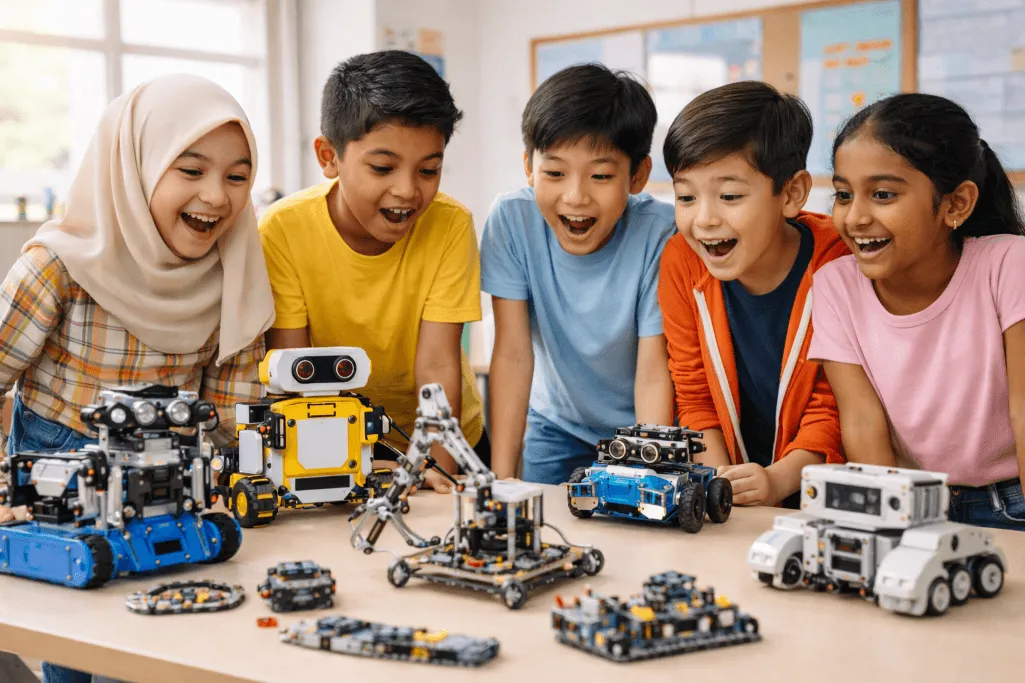
Robotics education is rapidly becoming a core component of modern learning, from early childhood classrooms to secondary schools. As demand grows, so does the variety of robotic educational equipment available in the market. However, not all tools are suitable for every age group.
A mismatch between a child’s developmental stage and the complexity of the equipment can lead to frustration, disengagement, or limited learning outcomes.
Conversely, selecting the right tools can significantly enhance cognitive development, problem-solving skills, and long-term STEM interest.
This guide provides a structured framework to help parents, educators, and institutions choose the most appropriate stem robotic kits and stem education kits for each learning stage.
What Is Robotic Educational Equipment?
Robotic educational equipment refers to structured learning tools that combine hardware (such as motors, sensors, and controllers) with software (coding platforms) to teach STEM concepts. These tools support hands-on learning in programming, engineering, and logical thinking.
Unlike simple toy robots, structured stem robotic kits are designed with educational outcomes in mind. They often align with curriculum standards and offer progressive learning pathways.
Key distinctions include:
- Toy robots: Entertainment-focused, limited learning depth
- STEM robotic kits: Curriculum-based, modular, and skill-oriented
- Modular systems: Expandable and scalable for long-term use
- Fixed systems: Limited flexibility, often beginner-level only
For schools looking to implement structured programmes, exploring comprehensive solutions such as robotic education equipment for schools in Malaysia can provide a strong foundation.
Learning Stage Framework
Early Childhood (Ages 4–6): Exploration & Logical Foundations
Developmental Characteristics:
- Developing fine motor skills
- Understanding cause-and-effect
- Recognising patterns
Learning Objectives:
- Build basic sequencing skills
- Encourage curiosity through play
- Introduce simple logic concepts
Recommended Equipment:
- Screen-free robotic educational equipment
- Button-based programmable robots
- Basic stem education kits with visual instructions
Why It Works:
At this stage, children learn best through play-based activities. Screen-free tools reduce cognitive overload and allow them to focus on physical interaction and sequencing logic.
Common Mistakes to Avoid:
- Introducing text-based coding too early
- Using overly complex interfaces
Lower Primary (Ages 7–9): Structured Introduction to Coding
Developmental Characteristics:
- Beginning computational thinking
- Ability to follow structured instructions
- Increased collaboration with peers
Learning Objectives:
- Understand basic coding concepts
- Build simple robotic systems
- Develop logical thinking
Recommended Equipment:
- Block-based programming stem robotic kits
- Entry-level sensor-based robots
- Modular building kits
Why It Works:
Visual coding platforms (such as drag-and-drop interfaces) make abstract concepts easier to understand. This reduces learning friction while encouraging experimentation.
Common Mistakes to Avoid:
- Choosing advanced systems requiring prior coding knowledge
- Overloading students with too many features
Upper Primary (Ages 10–12): Problem Solving & Engineering Thinking
Developmental Characteristics:
- Stronger analytical reasoning
- Ability to manage multi-step processes
- Interest in experimentation
Learning Objectives:
- Develop problem-solving skills
- Understand sensors and automation
- Apply logic to real-world scenarios
Recommended Equipment:
- Advanced stem robotic kits with multiple sensors
- Robotics kits with Bluetooth or WiFi integration
- Intermediate stem education kits supporting variables
Why It Works:
Students at this stage can grasp abstract concepts such as variables and loops. Robotics projects become more meaningful when linked to real-world applications.
Common Mistakes to Avoid:
- Using overly simplified kits that limit challenge
- Lack of project-based learning opportunities
Secondary School (Ages 13–17): Advanced Robotics & Real-World Applications
Developmental Characteristics:
- Advanced logical reasoning
- Interest in engineering and innovation
- Ability to work independently
Learning Objectives:
- Develop algorithms
- Build complex robotic systems
- Prepare for STEM careers
Recommended Equipment:
- Microcontroller-based robotic educational equipment
- Python or C-based programming kits
- AI-enabled robotics platforms
Why It Works:
This stage bridges education and industry. Students gain hands-on experience with technologies used in real-world applications, preparing them for future careers.
For those exploring career pathways, understanding how robotics connects to future industries is essential.
More information may refer : robotic education equipment for Industry 4.0 careers
Common Mistakes to Avoid:
- Using closed systems that limit expansion
- Avoiding real-world project integration
Comparative Framework: Robotics Equipment by Learning Stage
Learning Stage | Cognitive Focus | Recommended Equipment Type | Programming Level | Complexity Level |
Early Childhood | Sequencing | Screen-free robotics | No coding | Low |
Lower Primary | Logic building | Block-based kits | Visual coding | Moderate |
Upper Primary | Problem solving | Sensor-integrated kits | Variables & loops | Intermediate |
Secondary | Engineering design | Microcontroller platforms | Text-based coding | Advanced |
What Educators Look for in Robotic Educational Equipment
Selecting the right robotic educational equipment goes beyond features. Educators typically evaluate:
- Curriculum alignment with STEM learning outcomes
- Expandability for long-term use
- Safety standards for classroom environments
- Technical support and training availability
- Assessment integration for tracking student progress
Working with experienced providers, such as those offering comprehensive robotics education services, ensures smoother implementation and better educational outcomes.
Key Evaluation Criteria Before Purchasing
Before investing in stem robotic kits or stem education kits, consider the following:
- Age suitability: Matches student cognitive level
- Software compatibility: Easy to use and scalable
- Hardware durability: Suitable for classroom use
- Upgrade potential: Supports long-term progression
- Teacher support: Training and resources available
Choosing scalable robotic educational equipment ensures that students can progress without needing to switch systems frequently.
Common Mistakes Parents and Schools Make
Many institutions and parents make avoidable mistakes when selecting robotics tools:
- Buying based on trends rather than educational needs
- Choosing kits that are too advanced for the learner
- Ignoring long-term progression pathways
- Overlooking technical support and training
- Focusing on features instead of learning outcomes
Avoiding these pitfalls ensures better return on investment and improved student engagement.
Conclusion
Robotics education is most effective when aligned with a learner’s developmental stage. The goal is not to introduce the most advanced technology, but to ensure a progressive learning journey.
The right robotic educational equipment builds confidence, strengthens STEM foundations, and prepares students for future careers. Whether for schools or parents, making informed decisions today can shape long-term learning success.
If you are looking to implement or upgrade your robotics programme, explore tailored solutions or contact a robotics education specialist to get started.
FAQ: Robotic Educational Equipment
At what age should children start using robotic educational equipment?
Children can start as early as 4 years old using simple, screen-free robotics tools designed for basic sequencing and motor skill development.
Are STEM robotic kits suitable for beginners?
Yes, many stem robotic kits are specifically designed for beginners, using visual coding and step-by-step instructions to simplify learning.
What is the difference between STEM education kits and robotics toys?
STEM education kits focus on structured learning and skill development, while robotics toys are mainly for entertainment with limited educational depth.
Do older students need text-based programming?
Yes, secondary students benefit from text-based programming such as Python or C, as it prepares them for real-world applications.
How do robotics kits support academic performance?
They enhance problem-solving, logical thinking, and creativity, which positively impact overall academic performance, especially in STEM subjects.

