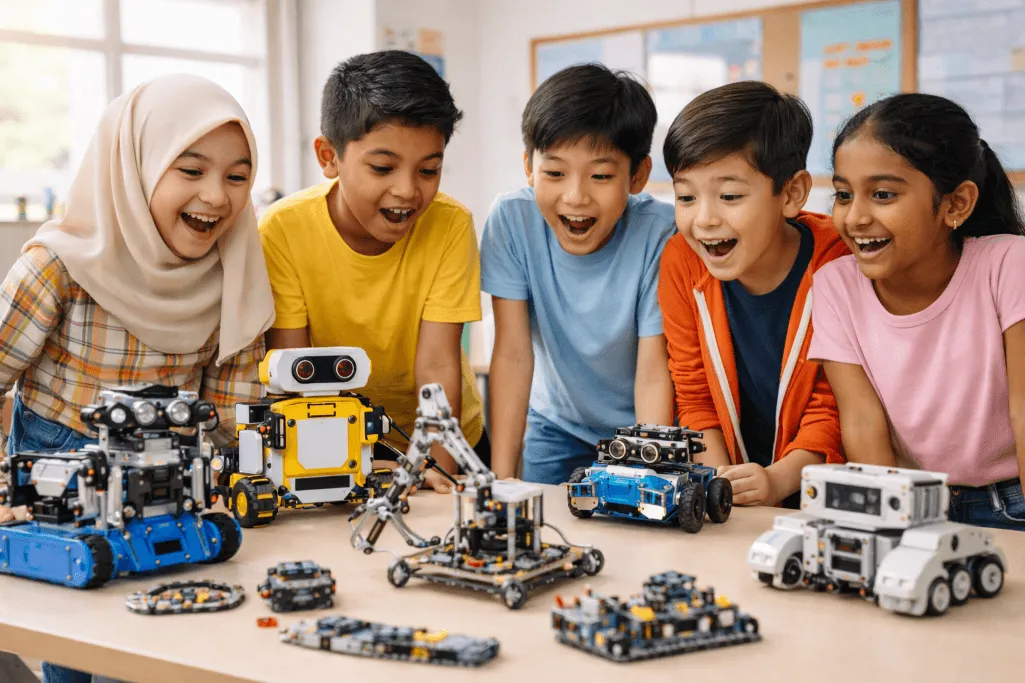

Why Beginners Often Fail in Robotics?
Robotics education is growing rapidly across Malaysia and globally. Parents, schools, and educators increasingly recognise its value in preparing students for future careers in engineering, AI, and technology.
However, despite this rising interest, many beginners quickly lose motivation or drop out altogether.
The issue is rarely a lack of interest. Instead, it often comes down to choosing the wrong robotic educational equipment at the start.
From experience working with STEM programmes, beginners commonly face frustration due to overly complex kits, lack of guidance, or mismatched learning expectations.
This guide takes a critical, structured approach to help you avoid these pitfalls and make informed decisions that support long-term learning success, not short-term excitement.
What Is Robotic Educational Equipment?
Robotic educational equipment refers to structured learning systems combining programmable hardware (such as motors, sensors, and controllers) with software interfaces to teach coding, engineering logic, and problem-solving through hands-on activities.
It is important to distinguish between:
- Toy robots: Entertainment-focused, limited learning depth
- STEM robotic kits: Designed with progressive learning pathways
- Advanced systems: Require prior coding or engineering knowledge
High-quality stem education kits are built to support gradual skill development, not just one-time assembly or play.
The 5 Most Common Beginner Mistakes in Robotics
Mistake 1: Choosing Equipment That Is Too Advanced
The Problem: Beginners start with complex systems requiring prior knowledge.
Why It Happens: Misleading marketing or overestimation of ability.
Long-Term Consequence: Frustration, loss of confidence, early dropout.
How to Avoid It: Start with structured, beginner-friendly kits using visual programming.
Mistake 2: Focusing Only on Hardware, Ignoring Software
The Problem: Emphasis on building, not coding.
Why It Happens: Robotics is often perceived as mechanical rather than logical.
Long-Term Consequence: Weak computational thinking skills.
How to Avoid It: Choose kits with strong programming interfaces and guided coding activities.
Mistake 3: Buying Based on Popularity Instead of Learning Goals
The Problem: Selecting viral or trending kits.
Why It Happens: Social proof and online hype.
Long-Term Consequence: Misalignment with learner’s age or curriculum.
How to Avoid It: Focus on educational outcomes, not brand popularity.
Mistake 4: Ignoring Expandability
The Problem: Using fixed, non-upgradable systems.
Why It Happens: Lower upfront cost.
Long-Term Consequence: Learners outgrow the kit quickly.
How to Avoid It: Select scalable stem robotic kits with add-ons and upgrades.
Mistake 5: Skipping Foundational STEM Concepts
The Problem: Jumping straight into robotics without basics.
Why It Happens: Desire for quick results.
Long-Term Consequence: Learning gaps and stagnation.
How to Avoid It: Ensure the kit integrates core STEM concepts like logic, sequencing, and problem-solving.
More information may refer : Essential Robotic Education Equipment Every School Should Have
The Beginner Suitability Framework
Choosing the right robotic educational equipment requires a structured evaluation. Use this framework:
1. Age & Cognitive Readiness
- Fine motor skills for assembly
- Ability to follow instructions
- Logical reasoning capability
2. Programming Interface Type
- Screen-free: Ideal for early learners
- Block-based coding: Best for beginners
- Text-based coding: Suitable only after foundational learning
3. Hardware Complexity
- Number of components
- Wiring difficulty
- Assembly requirements
4. Learning Curve & Documentation
- Step-by-step tutorials
- Project-based learning
- Video and visual guides
5. Expandability & Scalability
- Additional sensors and modules
- Software upgrades
- Advanced learning pathways
A well-designed stem education kit should grow alongside the learner.
Beginner Equipment Comparison
Criteria | Poor Beginner Choice | Ideal Beginner Choice |
Programming | Text-based only | Block-based visual |
Assembly | Complex wiring | Modular plug-and-play |
Instructions | Minimal guidance | Structured tutorials |
Expandability | Closed system | Upgrade-friendly |
Learning Outcome | Trial-and-error frustration | Progressive skill building |
This comparison highlights a key point: the best equipment is not the most advanced—it is the most suitable.
Essential Features to Look For
When selecting robotic educational equipment, prioritise these features:
1. Visual Programming Interface
Helps beginners understand logic without syntax complexity.
2. Durable and Safe Hardware
Ensures repeated use and safe handling, especially for younger learners.
3. Curriculum-Aligned Projects
Supports structured learning rather than random experimentation.
4. Community or Technical Support
Access to tutorials, forums, or guidance enhances learning continuity.
5. Error-Friendly Design
Encourages trial and error without discouraging failure.
These features are critical in transforming robotics from a hobby into a structured learning journey.
Why Foundational Robotics Matters for Long-Term STEM Success
Robotics is not just about building machines. It develops core competencies essential for future careers.
Key Benefits:
- Computational Thinking: Breaking down complex problems into logical steps
- Engineering Mindset: Understanding systems and how components interact
- Problem-Solving Skills: Iterative testing and improvement
- Resilience: Learning through failure and refinement
Well-designed stem robotic kits help students develop these skills early, creating a strong foundation for advanced STEM learning.
More information may refer : What Are STEM Robotics Kits? A Guide to Educational Technology
Questions to Ask Before Purchasing
Before investing in any robotic educational equipment, consider:
- Is it suitable for the learner’s age and skill level?
- Does it provide structured learning projects?
- Can it scale as the learner improves?
- Is the programming interface beginner-friendly?
- Does it align with STEM education objectives?
These questions ensure you are making a strategic, not impulsive, decision.
Conclusion
Success in robotics does not depend on expensive or advanced tools—it depends on choosing the right starting point.
By selecting appropriate robotic educational equipment, beginners can avoid frustration, build confidence, and develop meaningful STEM skills. A structured, scalable approach ensures that learning remains engaging, progressive, and impactful over time.
Ultimately, smart selection today leads to stronger STEM competency tomorrow.
If you’re exploring the right robotic educational equipment for your school, learning centre, or child, choosing the right solution can make all the difference in long-term success.
Our team is here to guide you with tailored recommendations, structured STEM programmes, and scalable learning solutions.
Feel free to get in touch with us for personalised advice or a quotation, and take a moment to explore our website to discover the full range of STEM robotics solutions we offer to support every learning stage.
FAQ (Beginner-Focused)
What is the best robotic educational equipment for beginners?
The best option is a kit with block-based programming, guided projects, and modular hardware. It should prioritise learning progression rather than complexity.
Are stem robotic kits suitable for children with no coding experience?
Yes. Many stem robotic kits are specifically designed for beginners using visual programming, making them accessible even without prior coding knowledge.
What age should beginners start robotics?
Children can start as early as 5–7 years with simple, screen-free or visual kits. More advanced systems are suitable from age 10 onwards.
How long does it take to learn basic robotics?
Basic understanding can develop within a few weeks, but mastering foundational skills typically takes several months of consistent practice.
What is the difference between robotics toys and stem education kits?
Robotics toys focus on entertainment, while stem education kits provide structured learning, coding integration, and progressive skill development.