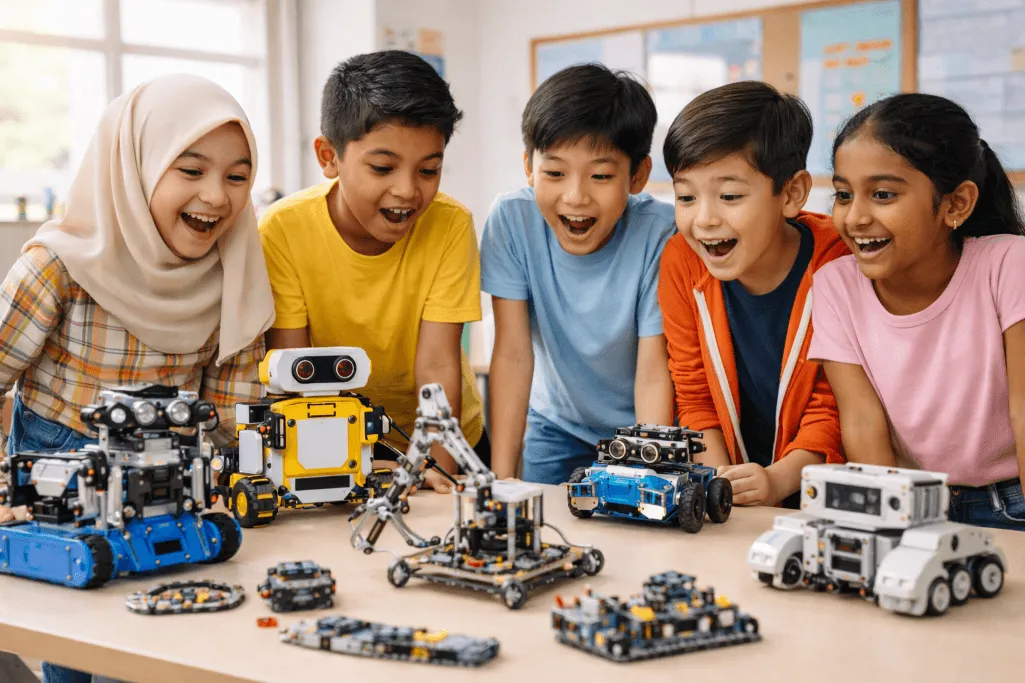

As education systems worldwide evolve to meet the demands of Industry 4.0, a key question is becoming increasingly relevant for schools in Malaysia: Are students being equipped with the right skills for a technology-driven future?
Robotics education is no longer an optional enrichment activity. It has become a vital component of modern learning, helping students develop problem-solving abilities, logical thinking, and digital literacy from an early age.
To deliver effective robotics education, schools need more than enthusiasm and lesson plans. They require the right robotic education equipment, designed to support both beginner learners and students progressing toward advanced, industry-relevant skills.
This article explores the essential robotic education equipment every school should have, from introductory tools to advanced systems, while highlighting the importance of robotics education in preparing students for the future.
Why Robotics Education Matters in Today’s Schools
Robotics education integrates science, technology, engineering, and mathematics (STEM) into hands-on learning experiences. Through robotics lessons, students move beyond theory and actively apply concepts such as logic, coding, mechanics, and electronics.
Educational research consistently shows that robotics learning:
- Enhances critical and computational thinking
- Encourages creativity and innovation
- Builds teamwork and communication skills
- Improves engagement in STEM subjects
- Prepares students for future technical careers
In Malaysia, robotics education aligns closely with national education goals focused on digital skills development, innovation, and workforce readiness. Introducing robotics at the school level helps bridge the gap between classroom learning and real-world technology applications.
Structuring Robotics Education: From Beginner to Advanced
An effective robotics programme should follow a structured, progressive approach. Schools are encouraged to provide equipment that supports:
- Beginner and introductory learning, where students develop foundational programming and logical thinking skills
- Advanced and applied learning, where students explore automation, assembly, and real-world robotic systems
This progression ensures that students build confidence and competence at every stage of their robotics learning journey.
Beginner and Introductory Robotic Education Equipment
1. Entry-Level Educational Robotics Kits
For students who are new to robotics, entry-level kits are essential. These kits introduce basic concepts such as sequencing, sensors, movement, and cause-and-effect relationships in an accessible way.
Key benefits include:
- Simple, easy-to-understand components
- Visual and block-based programming interfaces
- Safe, classroom-friendly design
- Encouragement of experimentation and hands-on learning
These kits form the foundation of beginner robotics classes and are well-suited for primary and lower secondary students.
2. Foundational Programming and Logic Platforms
Robotics education begins with logic and structured thinking. Beginner equipment should support core programming concepts such as loops, conditions, and simple algorithms.
Common features of foundational platforms include:
- Drag-and-drop coding environments
- Visual programming tools
- Simple command-based controls
These tools allow students to grasp programming logic intuitively before transitioning to text-based coding languages. At this stage, the integration of physical robots with programming concepts helps reinforce learning through real-world interaction.
3. Modular Robotics Systems for Exploration
Modular robotics systems enable students to build and reconfigure robots in multiple ways. This approach promotes creativity, experimentation, and design thinking.
Through modular systems, students gain exposure to:
- Basic mechanical structures
- Motor control and movement principles
- Sensor integration and feedback
Such systems are especially effective in project-based learning environments, where students collaborate to solve challenges and design functional robotic solutions.
Intermediate Robotics Equipment for Skill Development
As students progress, intermediate robotics equipment plays a crucial role in bridging basic concepts with more advanced applications. At this level, learning focuses on:
- More complex programming logic
- Introduction to text-based coding
- Problem-solving through structured robotics challenges
Intermediate robotics activities often include tasks such as line-following robots, obstacle detection, and automated responses based on sensor input. These activities help students apply theoretical knowledge in practical scenarios.
Advanced and Industrial Robotic Education Equipment
1. Advanced Programming and Automation Systems
Advanced robotics equipment exposes students to automation concepts commonly used in industrial environments. These systems typically support:
- Advanced programming languages
- Integration with control and automation systems
- Multi-axis movement and precision control
Such equipment is suitable for upper secondary schools, technical institutions, and vocational programmes offering specialised robotics courses.
2. Robotic Assembly and Industrial Simulation Equipment
To better prepare students for real-world applications, advanced robotics education may include assembly-focused systems. These systems help students understand:
- Industrial robot arms and manipulators
- Automated assembly processes
- Safety procedures in robotic environments
Exposure to industrial-style robotics helps bridge the gap between education and workforce readiness.
3. Robotic Welding and Industrial Process Training Systems
For technical and vocational education, robotic welding and industrial process simulation equipment provides valuable hands-on experience. Students can learn:
- Precision control in robotic operations
- Programming for repetitive industrial tasks
- Fundamental concepts of smart manufacturing
Although designed for educational use, these systems closely mirror real industrial applications.
The Role of Robotics Classes and Courses in Schools
Robotic education equipment delivers the greatest impact when integrated into well-structured robotics classes and courses. Schools that implement comprehensive programmes often see stronger student engagement and improved learning outcomes.
Effective robotics programmes typically include:
- Clear learning objectives at each level
- Progressive skill development
- Hands-on project-based activities
- Assessment through practical application
Robotics education also encourages interdisciplinary learning by combining mathematics, science, and technology within a single learning framework.
Benefits of Investing in Comprehensive Robotic Education Equipment
Schools that invest in a complete robotic education ecosystem gain multiple long-term benefits, including:
- Higher student engagement through interactive learning
- Improved STEM performance across subjects
- Development of future-ready skills aligned with industry needs
- Enhanced reputation as forward-thinking educational institutions
- Stronger support for national digital education initiatives
Robotic education equipment is not merely a teaching aid—it is a strategic investment in students’ futures.
Choosing the Right Robotics Equipment for Malaysian Schools
When selecting robotics equipment, schools should consider several key factors:
- Student age groups and learning levels
- Alignment with curriculum objectives
- Safety, durability, and reliability
- Scalability for future expansion
- Availability of training and technical support
Selecting equipment that can grow alongside students ensures long-term value and sustainability.
Robotics Education and the Future of Learning
As automation, artificial intelligence, and smart systems continue to transform industries, robotics education equips students to participate actively in the future economy rather than passively observe it. Schools that integrate robotics into their teaching empower students with adaptable skills relevant across multiple career paths.
By providing a balanced mix of beginner, intermediate, and advanced robotic education equipment, schools create inclusive learning environments where students can explore technology, build confidence, and discover potential career opportunities.
Conclusion: Building Strong Foundations Through Robotics Education
Robotics education is no longer optional—it is essential. From foundational programming and logical thinking to advanced industrial systems, the right robotic education equipment enables schools to deliver meaningful, future-focused learning experiences.
By investing in structured robotics classes, well-designed courses, and scalable educational robotics solutions, schools in Malaysia can nurture innovation, technical competence, and problem-solving abilities that prepare students for a rapidly evolving world.
Explore reliable robotics education solutions for schools. Contact us now.