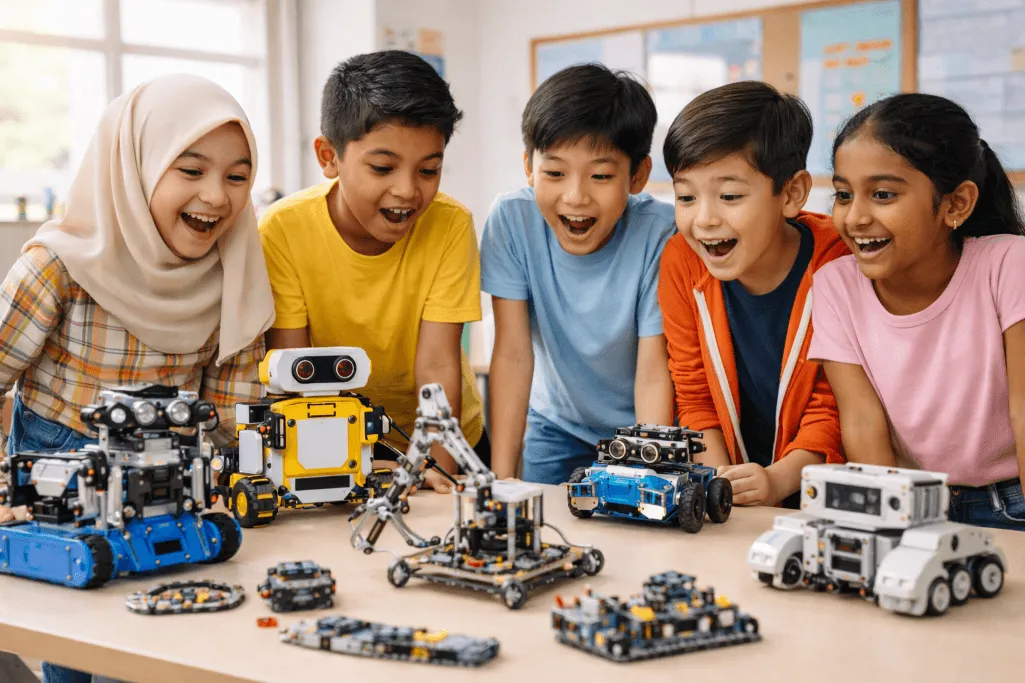

STEM robotics kits give students a practical way to learn coding, engineering, electronics and problem-solving through real projects. Instead of learning concepts only from textbooks, students can build a robot, programme its behaviour, test sensors and improve the design when something does not work as expected.
For schools, however, choosing a robotics kit is not simply about buying the most advanced system. The right kit should match the students’ age, coding experience, curriculum goals and the level of progression the school wants to provide over time.
This guide explains how STEM robotics kits support learning, how to compare different types of kits, and what schools should consider before introducing robotics into the classroom.
What Are STEM Robotics Kits?
STEM robotics kits are educational systems that combine mechanical parts, electronics, sensors and programming tools to help students apply Science, Technology, Engineering and Mathematics concepts through hands-on activities.
A typical kit may include structural components, motors, controllers, sensors, cables and coding software. Students use these parts to build robots that can move, detect objects, follow instructions or react to their surroundings.
The educational value comes from the process. Students are not simply assembling a finished product. They need to understand how the parts work together, write or modify code, test the robot and solve problems when the result does not match their original plan.
This makes robotics especially suitable for project-based learning, where students develop both technical knowledge and practical problem-solving skills.
Why STEM Robotics Kits Are Useful in Schools
One of the main advantages of robotics is that it connects several STEM subjects within a single activity.
For example, a student programming a robot to travel a specific distance may need to calculate speed, understand measurement, adjust motor power and use coding logic. If the robot turns too far or stops too early, the student must analyse the problem and make changes.
This process helps students understand that mathematics, science, engineering and technology are not isolated subjects. They often work together when solving real-world problems.
Robotics also encourages students to learn through experimentation. A failed test is not necessarily treated as a wrong answer. Instead, students identify the cause, adjust the design or code and test again. This iterative process develops persistence, logical thinking and confidence in problem-solving.
Group-based robotics projects can also strengthen communication and teamwork because students may take responsibility for different tasks such as building, programming, testing or presenting the final solution.
How to Choose the Right STEM Robotics Kits
The best STEM robotics kits are not always the ones with the most components or the most advanced technology. Schools should first determine who will use the kits and what students are expected to learn.
Match the Kit to the Student’s Learning Level
Younger or first-time learners usually benefit from kits with simple construction and visual programming. The goal at this stage is to understand basic sequences, movement and cause-and-effect relationships without introducing unnecessary technical complexity.
As students progress, the robotics system should allow them to work with sensors, conditional logic, variables and more open-ended engineering challenges.
Secondary or advanced students may benefit from platforms that support text-based programming such as Python or C++, together with microcontrollers, multiple sensors and expandable electronic components.
A structured progression is generally more effective than giving every age group the same robotics kit.
| Learning Stage | Suitable Robotics Features | Main Learning Focus |
|---|---|---|
| Beginner | Simple construction, visual coding, basic motors | Sequencing and basic logic |
| Intermediate | Multiple sensors, loops, variables, wireless control | Problem-solving and automation |
| Advanced | Microcontrollers, text-based coding, expandable electronics | Engineering, coding and robotics systems |
Programming Platform Matters
The coding environment is one of the most important factors when comparing STEM robotics kits.
For beginners, block-based programming can make coding easier to understand because students can drag and arrange commands visually instead of worrying about syntax.
As students become more confident, they should ideally be able to move towards more advanced programming concepts such as conditions, variables and functions.
For older students, text-based languages can provide a stronger foundation for computer science, automation, engineering and related technical fields.
Schools planning a long-term robotics programme should therefore consider whether the platform supports progression. A system that works well for beginners but cannot grow with students may need to be replaced later, which can increase cost and disrupt learning continuity.
Sensors and Expandability
Sensors are what allow a robot to interact with its environment.
Depending on the robotics system, students may work with distance, light, colour, motion or infrared sensors. These components allow them to create projects such as obstacle-avoiding robots, line-following systems or automated responses to changing conditions.
Expandability is equally important. A modular kit that accepts additional motors, sensors or controllers can support more complex projects as students progress.
For schools, this can provide better long-term value because the same ecosystem can be used across different learning levels instead of purchasing a completely separate platform each time students advance.
Teaching Resources Are as Important as Hardware
A common mistake is focusing entirely on the robotics kit itself.
Even good hardware can remain underused if teachers do not have suitable lesson plans, activities or technical support.
Schools should evaluate whether the robotics system includes:
- teacher guides
- lesson plans
- project examples
- coding tutorials
- assessment activities
- technical support
- teacher training
These resources help educators connect robotics activities to actual learning outcomes rather than treating the equipment as an isolated technology project.
For schools introducing robotics for the first time, teacher confidence can be just as important as student interest.
STEM Robotics Kits by Learning Goal
Different schools may have different reasons for introducing robotics. Some want to strengthen coding education, while others may be preparing students for competitions or building a broader STEM programme.
| Learning Goal | Useful Kit Characteristics |
|---|---|
| Introduce coding | Visual programming and simple movement |
| Develop problem-solving | Sensors and open-ended challenges |
| Teach engineering | Modular mechanical components |
| Introduce electronics | Microcontrollers and circuit-based activities |
| Support competitions | Durable, expandable and programmable systems |
| Teach automation | Multiple sensors and advanced programming |
| Introduce AI concepts | Compatible cameras, processors or advanced software |
Defining the learning objective first helps schools avoid buying equipment that is impressive but unsuitable for the intended classroom use.
How STEM Robotics Kits Can Be Used in the Classroom
Robotics does not need to be taught as a completely separate subject.
A well-planned robotics activity can support several areas of the curriculum.
In mathematics, students can calculate distance, speed, turning angles or ratios.
In science, robotics can help demonstrate concepts related to motion, force, energy and electricity.
In computer science, students can practise sequencing, loops, conditions and algorithms.
In engineering or design activities, students can build a prototype, test the structure and improve it after identifying weaknesses.
This makes robotics especially useful for interdisciplinary STEM projects.
For example, a teacher may ask students to design a robot that can move through an obstacle course while carrying an object. To complete the task successfully, students need to combine mechanical design, coding, measurement and testing rather than relying on knowledge from only one subject.
Example Robotics Learning Progression
Schools can introduce robotics gradually rather than moving directly into advanced projects.
A beginner activity may simply require students to programme a robot to move forward, stop and turn at a specific angle. This introduces sequencing and basic measurement.
At an intermediate level, students could use a distance sensor to detect an obstacle and automatically change direction. This adds conditional logic and sensor integration.
Advanced students might be asked to design an autonomous robot that navigates a course without direct control. This requires students to combine programming, sensors, mechanical design, testing and troubleshooting.
The progression can be summarised as:
Build → Programme → Test → Troubleshoot → Improve
This process is valuable because students learn that engineering involves repeated refinement rather than achieving a perfect result on the first attempt.
STEM Robotics Kits for Clubs and Competitions
Robotics kits can also be used outside normal classroom lessons.
STEM or robotics clubs give students more time to experiment with designs and develop longer-term projects. They can also allow students from different age groups to collaborate.
Competition-based activities can introduce a stronger problem-solving element because students must work towards a specific goal or performance requirement.
Typical challenges may include:
- line-following robots
- obstacle courses
- robot sumo
- autonomous navigation
- engineering design challenges
When selecting kits for competitions, schools should consider durability, replacement parts, programming flexibility and whether the system can be modified as students improve their designs.
How Many STEM Robotics Kits Does a School Need?
The number of kits required depends on class size and the way activities are structured.
Robotics often works well as a collaborative activity, so schools do not necessarily need one kit for every student.
For many classroom projects, two to four students can share one kit effectively. One student may focus on programming while another works on construction, testing or documentation.
Before purchasing, schools should consider:
- number of students per class
- number of students per group
- how frequently the kits will be used
- whether several classes will share the equipment
- storage requirements
- battery or charging needs
- availability of replacement components
Running a smaller pilot programme first can help schools determine the ideal quantity before making a larger investment.
Common Mistakes When Buying STEM Robotics Kits
One of the most common mistakes is choosing a system that is too advanced for the students.
A robotics kit may look more impressive because it supports complex programming or advanced sensors, but those features provide little educational value if students cannot use them confidently.
Another mistake is selecting a platform based only on the initial purchase price. Schools should also consider replacement parts, teacher training, software requirements and long-term expandability.
A cheaper kit may become expensive if damaged components cannot be replaced or if the system must be completely changed when students progress.
Schools should also avoid introducing robotics without clear learning objectives. Before buying equipment, decide whether the programme is intended to support coding, STEM enrichment, engineering, competition preparation or more advanced automation learning.
Questions Schools Should Ask Before Buying Robotics Kits
Before choosing a supplier or robotics platform, schools should ask practical questions such as:
- Which age group is the kit designed for?
- What programming environment does it use?
- Can students progress from visual to text-based coding?
- Which sensors and components are included?
- Can additional parts be added later?
- Are lesson plans and teacher guides provided?
- Is teacher training available?
- Are replacement parts easy to obtain?
- How many students should share one kit?
- Is technical support available after purchase?
These questions help schools evaluate the complete learning solution rather than comparing hardware alone.
How to Start a STEM Robotics Programme
Schools introducing robotics for the first time do not need to implement a large programme immediately.
A practical approach is to begin with one class, age group or robotics club.
First, define the learning goal. Decide whether students are expected to learn basic coding, engineering, automation or competition skills.
Next, choose an age-appropriate robotics system and provide teachers with enough training to operate and troubleshoot the equipment.
After several lessons, review how students respond to the activities. Schools can then identify whether the programme needs additional kits, more advanced equipment or different teaching resources.
Once the pilot is successful, the programme can be expanded gradually across other classes or learning levels.
Choosing STEM Robotics Kits for Long-Term Learning
The most effective STEM robotics kits are those that can support students beyond their first few lessons.
Instead of focusing only on how quickly students can build a robot, schools should consider whether the platform can continue challenging learners as their coding, engineering and problem-solving abilities improve.
A strong robotics programme should offer a clear pathway from introductory construction and visual coding towards sensors, automation, programming and more advanced engineering projects.
This allows robotics to become part of a broader STEM learning strategy rather than a one-time classroom activity.
Frequently Asked Questions
What are STEM robotics kits?
STEM robotics kits are educational systems that combine mechanical components, electronics, sensors and programming tools. Students use them to build and programme robots while learning concepts related to science, technology, engineering and mathematics.
Which STEM robotics kits are best for schools?
The best kit depends on student age, coding experience and learning goals. Beginners usually benefit from simple construction and visual programming, while older students may require sensors, microcontrollers and text-based coding.
What age can students start learning robotics?
Students can begin with simple robotics activities at primary-school level. The complexity of the construction and programming should increase gradually as students become more confident.
Do STEM robotics kits teach coding?
Yes. Many robotics systems introduce programming through visual block-based tools, while more advanced platforms may support languages such as Python or C++.
Can robotics kits be used in normal STEM lessons?
Yes. Robotics can support mathematics, science, computer science, engineering and design activities because students need to apply several concepts within one practical project.
How many students should share one robotics kit?
Two to four students per kit can work well for many classroom activities because robotics naturally supports teamwork. The ideal ratio depends on the kit, project complexity and class size.
What should schools consider before buying robotics kits?
Schools should compare age suitability, programming platform, sensors, durability, expandability, teaching resources, teacher training, technical support and replacement-part availability.
Are expensive robotics kits always better?
No. The best robotics kit is the one that matches the intended learning outcome. A simpler kit can often be more effective for beginners than a complex platform with features students are not ready to use.
Build a Robotics Programme That Grows With Students
STEM robotics kits can provide much more than an introduction to coding. When selected and implemented properly, they can help students connect mathematics, science, engineering and technology through practical problem-solving.
For schools, the priority should be finding a robotics system that matches the students’ current level while providing enough flexibility for future progression.
A strong programme combines appropriate hardware, structured learning activities, teacher support and opportunities for students to build, test and improve their own solutions.
MFTech Global supports schools and educational institutions in selecting STEM robotics kits, educational technology and related learning solutions based on student level, curriculum goals and long-term STEM education requirements.