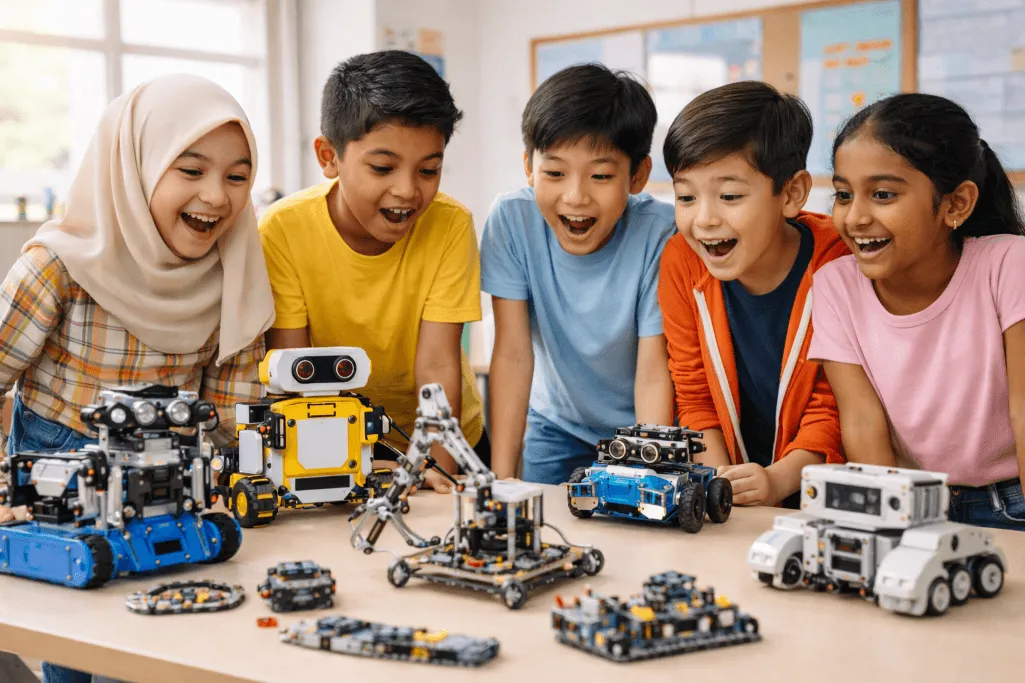

The demand for stem robotic kits has grown rapidly across schools and homes, driven by the increasing importance of digital skills and hands-on learning.
Parents and educators are recognising that robotics is no longer a niche subject. It is becoming a core part of modern education.
From primary classrooms to secondary school programmes, robotics is being integrated to support problem-solving, coding, and engineering thinking. However, despite this growing adoption, several misconceptions still prevent wider acceptance.
This article aims to debunk common myths surrounding stem robotic kits using educational research, classroom practices, and industry insights. Helping you make informed decisions with confidence.
What Are STEM Robotic Kits?
Definition:
A STEM robotic kit is a structured learning tool that combines hardware (such as sensors, motors, and controllers) with software (programming interfaces) to teach students robotics, coding, and engineering through hands-on activities.
Key Components:
- Microcontrollers or programmable boards
- Sensors (light, distance, motion)
- Motors and mechanical parts
- Programming platforms (block-based or text-based)
More information may refer : What Are STEM Robotics Kits? A Guide to Educational Technology
How They Differ from General Robotic Educational Equipment:
While general robotic educational equipment may focus on demonstration or basic interaction, stem robotic kits are curriculum-driven, designed to support progressive learning and skill development.
Educational Value:
These kits support:
- Computational thinking
- Engineering design processes
- Logical reasoning
- Real-world problem-solving
Grounded in experiential and inquiry-based learning, they help learners actively construct knowledge rather than passively receive it.
✅ Core Section: Myth vs Reality
Myth 1: STEM Robotic Kits Are Only for “Gifted” Students
The Myth:
Only academically strong or “gifted” students can benefit from robotics.
The Reality:
Modern stem robotic kits are designed for all learning levels, with beginner-friendly modules and step-by-step progression.
Educational Insight:
Based on growth mindset theory and scaffolding, students learn effectively when tasks are structured and gradually increase in complexity.
Practical Example:
A student with no coding background can start with drag-and-drop programming and progress to more advanced logic over time.
Myth 2: Robotic Educational Equipment Replaces Traditional Learning
The Myth:
Robotics replaces subjects like maths and science.
The Reality:
Robotics enhances and reinforces traditional subjects by applying theory in real-world scenarios.
Educational Insight:
According to constructivist learning theory, students retain knowledge better when they actively apply concepts.
Practical Example:
Students use robotics to apply:
- Physics (motion, force)
- Mathematics (angles, measurement)
- Coding (logic, sequencing)
Myth 3: STEM Educational Kits Are Too Expensive for Real Value
The Myth:
Robotic kits are costly and not worth the investment.
The Reality:
A well-designed stem educational kit offers long-term value through reusability and multi-subject integration.
Educational Insight:
These kits develop essential skills such as:
- Logical reasoning
- Systems thinking
- Collaboration
- Digital literacy
Practical Example:
One kit can be used across multiple projects, levels, and subjects—making it cost-effective over time.
Myth 4: Robotics Is Just Playing With Toys
The Myth:
Robotics is simply playtime without real learning outcomes.
The Reality:
Robotics programmes are structured and curriculum-aligned, often involving coding, engineering principles, and problem-solving tasks.
Educational Insight:
Play-based learning has been proven to improve:
- Cognitive retention
- Engagement
- Executive function skills
Practical Example:
Students programme robots to follow paths, respond to sensors, or complete challenges—requiring logical thinking and testing.
Myth 5: STEM Robotic Kits Are Too Complicated for Young Children
The Myth:
Young learners cannot handle robotics due to complexity.
The Reality:
Many kits are designed with age-appropriate, modular systems and visual programming interfaces.
Educational Insight:
Early exposure supports:
- Fine motor skills
- Computational thinking
- Confidence in problem-solving
Practical Example:
Primary school students can use simple block-based coding to control movement and actions without prior experience.
Myth 6: Robotics Only Benefits Future Engineers
The Myth:
Robotics is only useful for those pursuing engineering careers.
The Reality:
Robotics develops transferable skills relevant across industries.
Educational Insight:
Aligned with 21st-century competencies, robotics builds skills applicable in:
- Healthcare (automation, diagnostics)
- Data science (logic, systems)
- Creative design (innovation)
- Entrepreneurship (problem-solving mindset)
Practical Example:
A student learning robotics gains analytical and creative thinking skills valuable in nearly any career path.
✅ Authority-Building Section
What Educators and Industry Experts Say
Globally, educators are increasingly integrating stem robotic kits into curricula due to their proven effectiveness.
Key Trends:
- Adoption in STEM-focused schools
- Integration into national education frameworks
- Increased demand for robotics-related skills in the workforce
Educational Frameworks Supporting Robotics:
- Inquiry-based learning
- Experiential education
- Project-based learning
Experts emphasise that robotics should be implemented strategically, not as a trend, but as a structured educational tool that supports measurable learning outcomes.
More information may refer : STEM Equipment for Schools: A Complete Supply Checklist for Pendidikan STEM in Sekolah Kebangsaan
✅ Buyer/Decision Support Section
How to Choose the Right STEM Robotic Kit
Selecting the right robotic educational equipment requires careful evaluation.
Key Factors to Consider:
1. Age Suitability
Ensure the kit matches the learner’s developmental stage.
2. Curriculum Alignment
Choose kits aligned with STEM learning objectives or school standards.
3. Expandability
Look for kits that allow upgrades and additional modules.
4. Software Compatibility
Check whether the programming platform suits beginners or advanced users.
5. Technical Support
Reliable support ensures smoother learning experiences.
6. Safety Certifications
Ensure materials and components meet safety standards.
A well-designed stem educational kit should support both structured learning and creativity, offering long-term educational value.
Conclusion
Many misconceptions about stem robotic kits stem from a lack of understanding rather than actual limitations. In reality, these tools are inclusive, practical, and highly effective in developing essential skills for the future.
Stem robotic kits play a critical role in modern education by combining hands-on learning, structured curriculum integration, and real-world application, stem robotic kits play a critical role in modern education.
Making informed decisions ensures that learners fully benefit from what robotics has to offer.
Feel free to contact us for more information or a personalised quotation, and we’ll guide you through the most suitable options. You can also explore our website to discover a full range of stem robotic kits designed for different learning stages.
Frequently Asked Questions
Are STEM robotic kits suitable for beginners?
Yes. Many stem robotic kits are designed with beginner-friendly interfaces, including visual programming and guided tutorials, allowing students with no prior experience to start learning effectively and progress at their own pace.
What age should children start using robotic educational equipment?
Children can begin as early as primary school age, typically around 6–7 years old, using simplified kits. More advanced robotic educational equipment is suitable for older students as their cognitive and technical skills develop.
Do STEM educational kits require prior coding knowledge?
No. Most stem educational kits introduce coding through visual, block-based platforms, making it easy for beginners. As learners progress, they can transition to more advanced programming languages like Python.
How do STEM robotic kits improve academic performance?
They enhance understanding by applying theoretical concepts in practical scenarios. This improves retention, problem-solving ability, and engagement, particularly in subjects like mathematics, science, and technology.
Are these kits aligned with school curriculum standards?
Many modern stem robotic kits are designed to align with STEM curriculum frameworks and educational standards, supporting structured learning outcomes in both formal classroom settings and informal education environments.